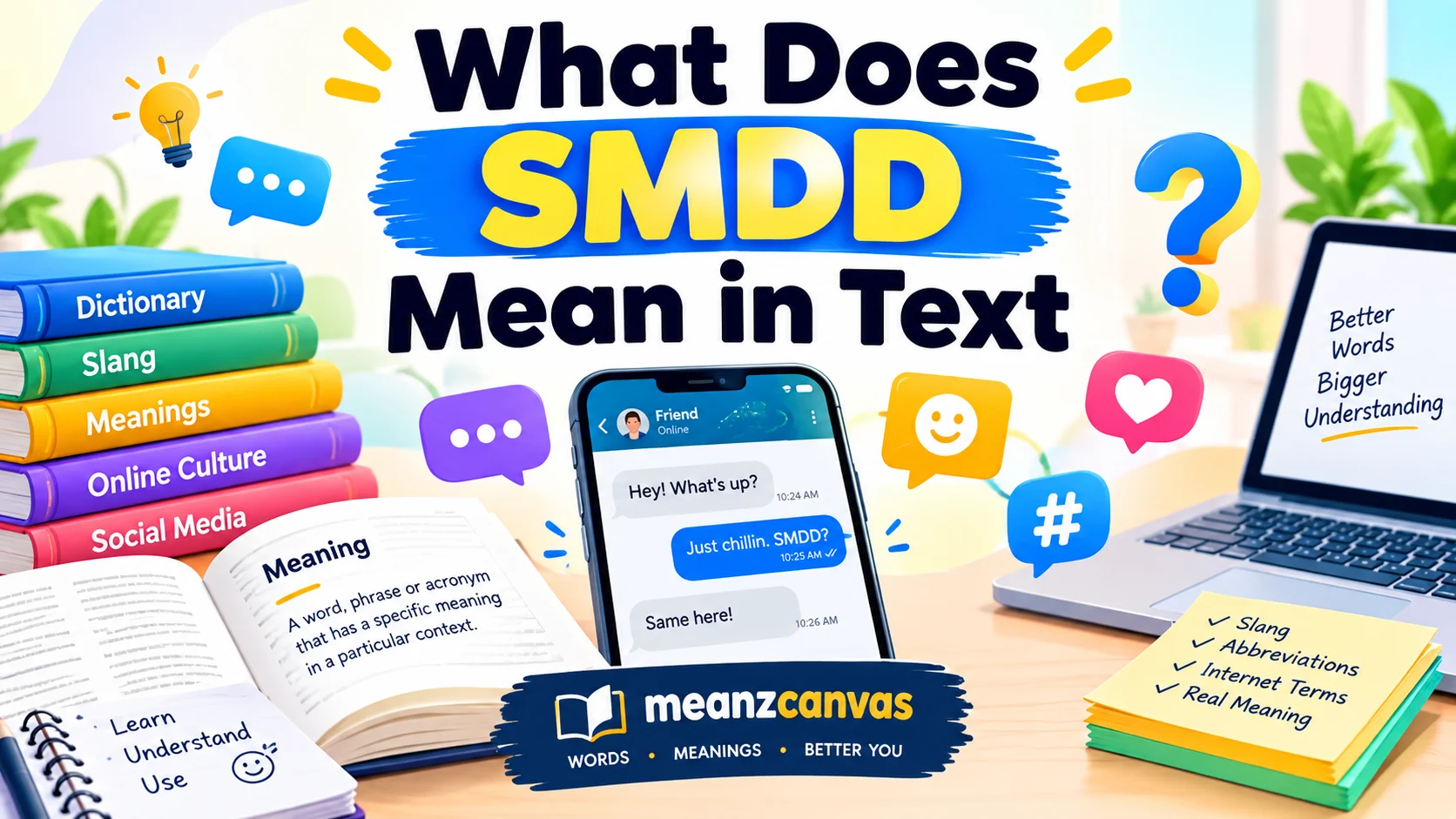
SMDD usually means “shake my damn head” in text, a stronger version of “SMH” used to show disbelief, annoyance, disappointment, or frustration.
You may see SMDD in texting, TikTok comments, Snapchat messages, Instagram posts, WhatsApp chats, and other casual online conversations. It is most common when someone wants to react strongly to something that seems ridiculous or frustrating.
People often search for the meaning because SMDD is less familiar than common abbreviations such as SMH, IDK, or BRB. If someone sends you “SMDD,” the exact feeling depends on the conversation, but it usually signals a negative or exasperated reaction.
SMDD Meaning in Text
In everyday online communication, SMDD means “shake my damn head.”
It is an informal expression used when someone cannot believe what another person has said or done. The word “damn” adds emphasis, making the expression stronger than simply saying “shake my head.”
For example:
“He forgot his keys again. SMDD.”
The person is basically saying, “I can’t believe he did that again.”
SMDD is generally an acronym or initialism rather than a traditional word. Each letter represents a word:
- S = Shake
- M = My
- D = Damn
- D = Head
The expression is closely related to SMH, which means “shaking my head” or “shake my head,” depending on how someone interprets the phrase.
The difference is mostly intensity. SMH can be used casually, while SMDD sounds more frustrated, dramatic, or emphatic.
What Does SMDD Express?
Someone might use SMDD when they feel:
- Disappointed
- Annoyed
- Frustrated
- Shocked
- Disbelieving
- Amused by someone’s poor decision
- Exasperated by something that keeps happening
For example:
“You really sent that email to the entire class? SMDD.”
Here, SMDD expresses disbelief and frustration.
It does not necessarily mean the sender is seriously angry. Friends may use it jokingly when someone makes a silly mistake.
SMDD vs. SMH
The easiest way to understand SMDD is to compare it with SMH.
SMH is generally softer and more widely recognized. It can mean something like, “I can’t believe this.”
SMDD adds stronger emphasis because of the word “damn.”
Compare:
“You forgot your homework again. SMH.”
This sounds mildly disappointed.
“You forgot your homework again? SMDD.”
This sounds more exasperated.
Because SMDD contains mild profanity, it is more casual and less suitable for formal communication.
Where People Use SMDD
SMDD can appear across several social and messaging platforms. However, it is not one of the most universal internet abbreviations, so people may encounter it less often than SMH, LOL, IDK, or TBH.
SMDD on TikTok
On TikTok, SMDD can appear in comments, captions, replies, or private messages.
Someone might comment:
“He really thought that was going to work. SMDD.”
The commenter is expressing disbelief or frustration about something shown in the video.
TikTok comments often use abbreviations because people want to react quickly without writing a complete sentence. The meaning is usually clear from the surrounding conversation.
Sometimes the expression is also used humorously. A person might use SMDD after watching a friend make an obviously bad decision.
SMDD on Snapchat
Snapchat conversations are usually informal, making abbreviations like SMDD more appropriate.
For example:
Friend: “I left my phone at home again.”
You: “SMDD 😂”
In this situation, the abbreviation could be playful rather than genuinely angry.
The tone depends heavily on the relationship between the people communicating.
SMDD on Instagram
On Instagram, you might see SMDD in comments, direct messages, captions, or replies.
For example, someone posts about making the same mistake twice, and a friend comments:
“Not you doing it again. SMDD.”
Here, the phrase can communicate friendly teasing.
It can also be used more seriously when reacting to disappointing news or someone’s questionable behavior.
SMDD on WhatsApp
WhatsApp conversations often involve friends, relatives, classmates, coworkers, and groups.
Because of that variety, the meaning of SMDD depends on who is using it.
Among close friends, it may be completely casual:
“You ordered pizza and forgot mine. SMDD.”
In a family or professional group, however, using an abbreviation containing profanity may not be the best choice.
SMDD in SMS or Text Messages
SMDD can also appear in ordinary phone texting.
Someone might write:
“He canceled at the last minute again. SMDD.”
The abbreviation saves time while still communicating an emotional reaction.
Traditional SMS texting helped popularize many shortened expressions because people wanted quick ways to communicate feelings without typing long sentences.
Real Chat Examples
Seeing SMDD in actual conversational contexts makes its meaning much easier to understand.
Example 1: Forgetting Something
A: Did you bring the tickets?
B: I thought you had them.
A: You said you were bringing them.
B: Oh no… SMDD.
Here, SMDD expresses frustration with the situation.
Example 2: A Friend Makes the Same Mistake
A: I forgot to save the file again.
B: Again??
A: Yep.
B: SMDD 😭
This is likely playful frustration rather than serious anger.
Example 3: Bad Decision
A: He spent all his money on something he doesn’t even need.
B: Seriously?
A: Yep.
B: SMDD.
The sender is expressing disbelief.
Example 4: Canceling Plans
A: She canceled our plans five minutes before we were supposed to leave.
B: No way.
A: Yep.
B: SMDD.
The expression shows annoyance about the cancellation.
Example 5: Funny Situation
A: I walked into the wrong classroom.
B: How did you not notice?
A: Everyone was staring at me.
B: SMDD 😂
Here, the phrase is humorous and teasing.
Example 6: Repeated Problem
A: My internet stopped working again.
B: Didn’t you just get it fixed?
A: Yesterday.
B: SMDD.
The abbreviation communicates exasperation.
Example 7: Online Drama
A: They started arguing over the same thing again.
B: After saying they were done with the drama?
A: Exactly.
B: SMDD.
The tone is one of disbelief.
Example 8: Small Mistake
A: I put my coffee in the fridge.
B: Why?
A: I have no idea.
B: SMDD 😂
This is a lighthearted use.
Example 9: Disappointing News
A: The event got canceled after everyone arrived.
B: You’re kidding.
A: I wish I was.
B: SMDD.
The expression shows disappointment and frustration.
Example 10: Friendly Teasing
A: Guess who forgot their password again?
B: You?
A: Obviously.
B: SMDD 😭
The phrase is being used jokingly between friends.
How to Reply When Someone Says “SMDD”
There is no single correct response to SMDD. Your reply should match the tone of the conversation.
If the person is genuinely frustrated, you can acknowledge the problem. If they are joking, a playful response works better.
Funny Replies
You could respond with:
- “I know, I know 😂”
- “That bad, huh?”
- “I deserve that.”
- “My brain stopped working.”
- “Okay, okay, I get it 😭”
These work well when the original message is clearly humorous.
Casual Replies
For an ordinary conversation, you could say:
- “Honestly, same.”
- “I can’t blame you.”
- “Yeah, that was bad.”
- “I know what you mean.”
- “It happens.”
These responses keep the conversation relaxed.
Friendly Replies
If a friend is annoyed, you might answer:
- “Sorry, my bad.”
- “You’re right.”
- “I’ll fix it.”
- “Okay, I learned my lesson.”
- “Fair enough.”
A simple acknowledgment can prevent a minor misunderstanding from becoming an argument.
Neutral Replies
If you are unsure whether SMDD is serious, keep your answer neutral:
- “What happened?”
- “Why do you say that?”
- “Everything okay?”
- “Did something go wrong?”
- “I get it.”
These replies give the other person room to explain their tone.
Is SMDD Rude or Offensive?
SMDD is not usually considered a serious insult, but it is informal and contains mild profanity.
The word “damn” makes it stronger than SMH. Whether that matters depends on the audience.
Among close friends, SMDD may be completely normal. In a professional environment, however, it can look too casual.
Is SMDD Safe to Use?
It is generally safe in informal conversations when you know the people involved are comfortable with casual slang.
For example, texting a close friend:
“You forgot your wallet again? SMDD.”
is probably fine.
But sending it to a teacher, manager, customer, or unfamiliar person may not be appropriate.
Is SMDD Appropriate at School?
That depends on the school’s communication rules and the context.
In a private conversation between friends, it may be treated as ordinary slang. In an assignment, presentation, official email, or message to a teacher, it is better to avoid it.
A more neutral alternative would be:
“I can’t believe that happened.”
Is SMDD Appropriate at Work?
Generally, avoid SMDD in formal workplace communication.
Even if your coworkers use slang, written professional communication is usually better without unnecessary profanity.
Instead of:
“SMDD, the meeting got canceled again.”
you could write:
“I can’t believe the meeting was canceled again.”
The second version communicates the same frustration without sounding overly casual.
Who Uses This Term?
SMDD is most likely to appear in informal online conversations, especially among people who already understand internet abbreviations.
Gen Z Usage
Gen Z is familiar with many abbreviated expressions, particularly on social media and messaging platforms. SMDD can fit naturally into that style of communication.
However, SMDD is not as universally popular as SMH.
Someone may understand SMH immediately but have to search for SMDD because it is less common.
Younger Internet Users
Teenagers and young adults may encounter SMDD in social media comments, group chats, gaming conversations, memes, and private messages.
Its use is generally conversational rather than formal.
Millennials and Older Users
Older internet users can also use or understand SMDD, especially if they regularly communicate through social media.
Internet slang is not limited to one generation. People often pick up expressions from friends, online communities, videos, and social platforms.
How Common Is SMDD?
SMDD is best described as a less common internet abbreviation.
That is important because seeing an unfamiliar acronym does not necessarily mean it has a completely different meaning. Sometimes a less-used variation develops from a much more familiar expression.
In this case, SMDD is closely connected to the idea behind SMH.
Origin of the Term
The exact origin of SMDD is difficult to pin down.
It appears to be a natural extension of the older expression “shake my head” and the widely recognized abbreviation SMH.
The phrase “shake my head” has long been used in everyday English to express disbelief, disappointment, disapproval, or frustration. Internet users shortened the expression to SMH as text messaging and online chat became more common.
SMDD follows the same basic abbreviation pattern while adding “damn” for emphasis.
The development makes sense in the broader history of internet language. Online communication often produces new abbreviations by modifying existing slang.
For example, users may add a word to an established abbreviation to make the emotional tone stronger.
Because internet slang evolves informally, there is not always a single person, website, or date that can be credited with creating an expression like SMDD.
That is why its precise origin should be treated as uncertain rather than presented as a confirmed historical fact.
SMDD vs. IDK vs. IDC vs. IMO vs. BRB
These abbreviations can all appear in text conversations, but they perform very different jobs.
| Term | Meaning | Type | Usage | Popularity |
|---|---|---|---|---|
| SMDD | Shake My Damn Head | Initialism/slang | Disbelief, frustration, disappointment | Less common |
| IDK | I Don’t Know | Initialism | Uncertainty or lack of knowledge | Very common |
| IDC | I Don’t Care | Initialism | Indifference | Very common |
| IMO | In My Opinion | Initialism | Giving an opinion | Very common |
| BRB | Be Right Back | Initialism | Temporarily leaving a conversation | Very common |
The key difference is emotional purpose.
SMDD is mainly a reaction.
IDK communicates uncertainty.
IDC communicates indifference.
IMO introduces an opinion.
BRB tells someone that you are temporarily stepping away.
Understanding this difference helps you interpret messages more accurately.
For instance:
“IDK, SMDD.”
could mean:
“I don’t know. I can’t believe this.”
Meanwhile:
“IMO, that’s the better choice.”
is simply someone giving their opinion.
Real-World Usage Example
Imagine two college friends are planning to meet for lunch.
One friend messages:
“I’m here. Where are you?”
The other replies:
“I thought lunch was at 2.”
The first friend responds:
“We literally said 1:30 yesterday.”
The second person realizes the mistake:
“Oh wow. SMDD.”
In this situation, the phrase expresses embarrassment and frustration with the mistake.
The friend might not actually be angry. They could simply be laughing at themselves for getting the time wrong.
This is an important part of understanding slang: the words alone do not always reveal the full emotion.
The relationship between the speakers, previous messages, punctuation, and surrounding context all influence the meaning.
If someone sends:
“SMDD 😂”
the laughing emoji may make the phrase feel playful.
If they send:
“SMDD.”
after a serious disagreement, it may sound much more frustrated.
Why People Confuse SMDD With SMH
If you search for SMDD, you may first encounter explanations for SMH.
That happens because the two expressions are closely related.
SMH is far more recognizable and generally means “shaking my head” or “shake my head.”
SMDD adds “damn,” which gives the reaction extra emphasis.
Think of it this way:
SMH: “I can’t believe this.”
SMDD: “I seriously can’t believe this.”
The exact emotional strength still depends on the speaker. Friends may use either expression casually.
It is also possible for people to interpret acronyms slightly differently. Internet slang does not always follow strict dictionary rules, and users sometimes create variations that make sense within their own communities.
When Should You Avoid Using SMDD?
There are situations where a more standard phrase is a better choice.
Avoid SMDD when:
- Writing a formal school assignment
- Contacting a teacher
- Writing a professional email
- Speaking to a customer
- Communicating with someone you do not know well
- Discussing a serious issue where clarity matters
- You are unsure whether the recipient understands slang
In those situations, simply say what you mean.
For example, instead of:
“SMDD, that’s ridiculous.”
you could write:
“I honestly can’t believe that happened.”
It is clearer and appropriate for a wider range of audiences.
How to Tell What SMDD Means From Context
If you see SMDD and are unsure how strongly the person means it, look at the surrounding message.
Consider these examples:
“You ate the last slice? SMDD 😂”
This probably sounds playful.
“He lied to everyone again. SMDD.”
This sounds more frustrated.
“SMDD, I can’t believe I forgot my keys.”
This is probably self-directed frustration.
Also consider who sent the message. A close friend may use stronger slang casually, while a stranger using the same abbreviation could sound more serious.
The safest approach is to interpret the overall conversation rather than treating the acronym as having only one emotional meaning.
Frequently Asked Questions
What does SMDD mean in text messages?
SMDD usually means “shake my damn head.” It expresses disbelief, annoyance, disappointment, or frustration.
What does SMDD mean on TikTok?
On TikTok, SMDD is generally used as a reaction to something ridiculous, surprising, disappointing, or frustrating. It can also be used jokingly in comments.
Is SMDD slang?
Yes. SMDD is informal internet slang in the form of an initialism. It is based on the expression “shake my damn head.”
Is SMDD rude or offensive?
It is not normally a serious insult, but it contains the mild swear word “damn.” Because of that, it is better suited to casual conversations than formal settings.
How should you reply to SMDD?
Your reply depends on the situation. You can say “I know, right?”, apologize if you caused the frustration, joke back with a friend, or simply ask, “What happened?”
Final Thoughts
SMDD usually means “shake my damn head.” It is an informal abbreviation used to show disbelief, frustration, disappointment, or amused annoyance.
You may encounter it in texts, TikTok comments, Snapchat messages, Instagram conversations, WhatsApp chats, and other casual online spaces.
The expression is related to SMH, but the added word “damn” gives SMDD a stronger and more emphatic tone.
It can be perfectly natural between friends, especially when someone is joking about a mistake or reacting to something ridiculous. However, because it contains mild profanity, it is better to avoid it in formal school or workplace communication.
If someone sends you “SMDD,” look at the context before assuming they are angry. In many conversations, it simply means, “I can’t believe this,” with a little extra emphasis.
Discover More Post
What Does LYR Mean in Text? Real Meaning Examples & Social Media Use 2026
What Does IHH Mean in Text? Real Meaning Examples & Social Media Use 2026