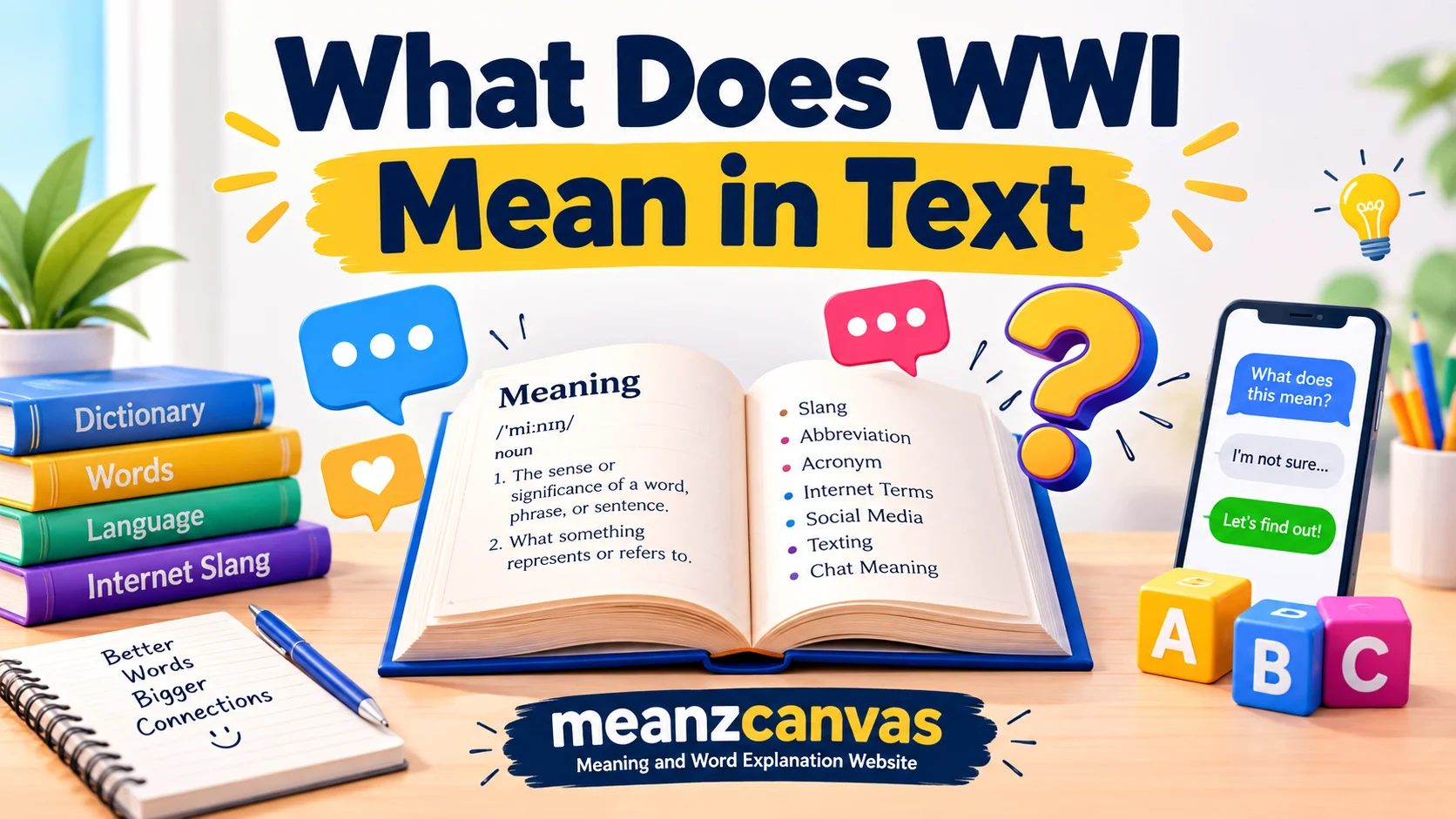
WWI in text usually means World War I, the major global war fought from 1914 to 1918. You may see “WWI” in texts, TikTok posts, Snapchat messages, Instagram captions, WhatsApp chats, and online discussions about history.
People often search for the meaning of WWI because the abbreviation can appear without any explanation. Unlike many texting terms, it is generally not modern internet slang. It is a common abbreviation for the historical event known as World War I.
The meaning is usually easy to understand from context. If someone says, “We are studying WWI tomorrow,” they are talking about World War I. If the conversation is about history, countries, battles, or the early 1900s, WWI almost certainly has this meaning.
WWI Meaning in Text
WWI means “World War I.” It is an abbreviation commonly used when referring to the First World War, which took place from 1914 to 1918.
In everyday messaging, people use WWI simply because writing three words as “World War I” can be shortened to four characters. It is especially common in school assignments, history discussions, educational posts, documentaries, articles, and online conversations.
WWI is not normally considered slang. It is better described as an abbreviation or shortened form of “World War I.”
For example:
“Did you finish the WWI assignment?”
Here, the person is asking whether someone completed an assignment about World War I.
Another example is:
“My class is covering WWI this week.”
Again, there is no hidden slang meaning. The writer is simply shortening the name of the historical conflict.
What Does WWI Stand For?
The letters stand for:
- W = World
- W = War
- I = One, represented by the Roman numeral I
Therefore:
WWI = World War I
You may also see the same event called the First World War or Great War, although “WWI” is one of the most familiar abbreviations.
Is WWI a Texting Acronym?
Technically, it is more accurate to call WWI an abbreviation than a typical texting acronym.
Texting acronyms such as “LOL,” “BRB,” and “IDK” are created from the first letters of phrases and are heavily associated with informal digital communication.
WWI is different. It is a widely recognized abbreviation used in both formal and informal writing.
You could see it in a school textbook, newspaper article, museum description, academic paper, or casual text message.
What Does WWI Mean in Everyday Chat?
In most conversations, WWI refers to the historical war that began in 1914 and ended in 1918.
For example:
A: “What chapter are you on?”
B: “The one about WWI.”
The meaning is straightforward: the second person is referring to the chapter about World War I.
Context is still important. Most of the time, however, there is little confusion when WWI is written in a historical or educational conversation.
Where People Use WWI
WWI can appear across many platforms, but the reason someone uses it is usually the same: they want a shorter way to write “World War I.”
The abbreviation is especially common when people are discussing history, school, documentaries, historical events, military history, or educational content.
WWI on TikTok
On TikTok, WWI can appear in educational videos, historical discussions, quizzes, documentaries, and short videos explaining events from the early twentieth century.
For example, a creator might write:
“Things you should know about WWI.”
Someone commenting might ask:
“What caused WWI?”
In this setting, WWI clearly refers to World War I.
TikTok also has a large amount of educational content, so an abbreviation that may look unfamiliar in a casual text can appear frequently in history-related videos.
WWI on Snapchat
Snapchat users may use WWI while discussing schoolwork or sharing information about history.
For example:
“I have a WWI test tomorrow.”
The abbreviation is simply a convenient shortcut.
It is not a special Snapchat expression with a different meaning.
WWI on Instagram
On Instagram, you may see WWI in captions, comments, reels, educational posts, historical pages, and museum content.
A history account might post:
“Rare photographs from WWI.”
A follower could comment:
“How long did WWI last?”
In both cases, the abbreviation means World War I.
WWI on WhatsApp
WhatsApp conversations can include WWI when friends, classmates, or family members are discussing history.
For example:
“Can you send me your WWI notes?”
This is especially common among students because abbreviations can make quick messages easier to type.
WWI in SMS
Traditional text messages can also use WWI.
Someone might write:
“The documentary is about WWI.”
There is no special texting rule behind it. It is simply a shorter version of the name.
Real Chat Examples Using WWI
The following examples show how WWI can naturally appear in everyday conversations.
Example 1: School Assignment
A: Did you start the history homework?
B: Not yet.
A: Same. We have to write about WWI.
B: I know. I still need to read the chapter.
Example 2: Studying for a Test
A: What are you studying?
B: WWI and the events leading up to it.
A: Is that on tomorrow’s test?
B: Yeah, unfortunately.
Example 3: Watching a Documentary
A: What are you watching?
B: A documentary about WWI.
A: Is it good?
B: Pretty interesting so far.
Example 4: Asking for Notes
A: Did you take notes in history today?
B: Yeah.
A: Can you send me the WWI notes?
B: Sure, I’ll send them tonight.
Example 5: Social Media Post
A: I saw a really interesting WWI video on TikTok.
B: Really? What was it about?
A: How the war changed Europe.
B: I’ll look for it.
Example 6: History Discussion
A: When did WWI end?
B: In 1918.
A: Thanks. I couldn’t remember the year.
B: No problem.
Example 7: Group Project
A: What topic did your group get?
B: WWI.
A: Nice. I’m doing ancient Egypt.
B: Both should be interesting.
Example 8: Watching a Historical Movie
A: Is that movie about WWI?
B: Yes.
A: I thought it was about WWII.
B: No, it’s set during the First World War.
Example 9: Casual Conversation
A: What was your favorite topic in history?
B: Probably WWI.
A: Really?
B: Yeah, I found the political history interesting.
Example 10: Preparing for Class
A: Are you ready for class?
B: Almost.
A: Did you review the WWI chapter?
B: That’s the one thing I forgot.
How to Reply When Someone Says “WWI”
Because WWI is not usually a slang expression, your response depends on the conversation.
If someone mentions it in a message, you can respond naturally without treating it like a special internet abbreviation.
Funny Replies
If the conversation is casual and humor is appropriate, you might say:
- “History class is calling again.”
- “Time to open the textbook.”
- “Here comes the history homework.”
- “My brain is still stuck in modern times.”
These replies work best between friends who already understand the context.
Casual Replies
For an ordinary conversation, you can say:
- “Oh, World War I?”
- “Yeah, I remember studying that.”
- “What part of WWI are you talking about?”
- “Are you working on a history assignment?”
Friendly Replies
If someone is asking about their schoolwork or sharing something interesting, a friendly response could be:
- “That sounds interesting.”
- “What are you learning about?”
- “Did you find anything surprising?”
- “I can help you look over your notes.”
Neutral Replies
For a straightforward response, try:
- “Yes, World War I.”
- “Are you referring to the First World War?”
- “What do you need to know about WWI?”
- “Which part of the topic are you studying?”
A neutral response is particularly useful if you’re not sure whether the person is using WWI in a historical context.
Is WWI Rude or Offensive?
No, WWI is not inherently rude or offensive.
It is a standard abbreviation for World War I and can be used in ordinary conversation, educational writing, and historical discussions.
The abbreviation itself is not insulting or inappropriate.
However, the context surrounding any historical topic matters. World War I involved enormous loss of life and suffering, so jokes or insensitive comments about the subject may be inappropriate depending on the audience and situation.
The abbreviation itself is not the problem.
Is WWI Safe to Use?
Yes. WWI is generally safe to use when you are referring to World War I.
It can be appropriate in:
- Text messages
- Social media posts
- School discussions
- Study groups
- History assignments
- Online educational conversations
- Informal writing
In formal academic writing, you can choose either “World War I” or “WWI,” depending on the style requirements of the assignment.
Can You Use WWI at School?
Yes.
Students commonly encounter WWI in history and social studies classes. Teachers and textbooks may use both “World War I” and “WWI.”
If you are writing an assignment, follow your teacher’s formatting preferences. If they ask you to write the full term rather than an abbreviation, use “World War I.”
Can You Use WWI at Work?
Usually, yes, especially when your work involves history, education, research, media, museums, journalism, or another subject where the term is relevant.
For professional communication, it is often useful to spell out the phrase the first time if there is any possibility that your audience may not recognize the abbreviation.
For example:
“The presentation covers World War I (WWI) and its aftermath.”
After that, using WWI may be perfectly clear.
Who Uses This Term?
WWI is used by a broad range of people because it is a standard abbreviation rather than a niche slang term.
Students may use it while discussing homework or tests. Teachers may use it in lesson materials. Historians, journalists, researchers, museums, and educational websites may also use it.
Gen Z Usage
Gen Z users may use WWI in texts, group chats, comments, and social media posts when discussing history.
However, it would be misleading to describe WWI as a uniquely Gen Z expression.
Unlike newer internet slang, WWI existed as a common abbreviation long before TikTok, Snapchat, Instagram, or modern texting became popular.
Younger Users
Younger people may encounter the abbreviation in school or through online educational content.
A student who sees “WWI” for the first time might search for its meaning because the abbreviation does not immediately look like common texting slang.
Older Users
Older generations also use and recognize WWI.
Its meaning is not tied to one particular age group.
Common Platforms
You can encounter WWI on:
- TikTok
- Snapchat
- YouTube
- Text messages
- Online forums
- Educational websites
The meaning generally stays the same across these platforms.
Origin of the Term
The abbreviation WWI comes from the name World War I.
The conflict began in 1914 and ended in 1918. It was later called World War I because another global conflict occurred from 1939 to 1945, commonly known as World War II.
Before World War II, the 1914–1918 conflict was often called the Great War or simply the World War. Once a second world war occurred, numbering the conflicts became a practical way to distinguish them.
The exact history of every abbreviation’s everyday adoption is not always easy to trace to one specific person or moment. However, WWI became an established shorthand for World War I and is now widely understood.
WWI vs. World War I
There is no major difference in meaning.
World War I is the full name.
WWI is the abbreviated form.
For example:
“I am studying World War I.”
and:
“I am studying WWI.”
Both sentences refer to the same historical conflict.
Is WWI Internet Slang?
Not really.
This is an important distinction if you are searching for the term because it appears in a text message.
Many abbreviations found online are slang. WWI generally isn’t.
It is a conventional abbreviation that happens to be convenient in digital communication.
WWI Compared With Other Common Text Abbreviations
WWI can look similar to popular texting abbreviations because it is short, but its function is different.
| Term | Meaning | Type | Usage | Popularity |
|---|---|---|---|---|
| WWI | World War I | Historical abbreviation | History, education, social media, messages | Common |
| IDK | I Don’t Know | Texting abbreviation | Casual chats and messages | Very common |
| IDC | I Don’t Care | Texting abbreviation | Casual or informal conversations | Very common |
| IMO | In My Opinion | Texting abbreviation | Online discussions and chats | Common |
| BRB | Be Right Back | Texting abbreviation | Casual messaging | Common |
The biggest difference is that WWI identifies a historical event, while the other four are expressions people use to communicate thoughts, reactions, or actions.
For example, “IDK” communicates uncertainty, while “BRB” tells someone that the speaker is temporarily leaving the conversation.
WWI does not communicate an emotion or reaction by itself. It simply refers to a specific historical event.
Real-World Usage Example
Imagine two classmates are preparing for a history exam.
One student sends a message:
“Did you review WWI yet?”
The other replies:
“Not completely. I reviewed the causes but haven’t studied the final years.”
In this situation, both students understand that WWI means World War I.
The abbreviation makes the message shorter without changing its meaning.
A similar situation could happen between a student and a parent:
“I need to finish my WWI project tonight.”
The parent doesn’t need to interpret the term as internet slang. The context makes it clear that the student is talking about a school project concerning World War I.
Another real-world example could involve social media. Someone watching a history video might comment:
“I never realized how much changed after WWI.”
Here again, the abbreviation is being used simply as a shorter form of the historical name.
Why People Search “What Does WWI Mean in Text?”
There are several reasons someone might search this question.
First, many people assume that any short expression in a text message could be slang. If they see “WWI” without historical context, they may wonder whether it has a newer internet meaning.
Second, abbreviations can be confusing when they are used without explanation. Someone might receive a message such as “We are covering WWI tomorrow” and want to know exactly what the writer means.
Third, social media has made historical abbreviations appear in more casual environments. A person who encounters WWI in a TikTok caption or Instagram comment may not immediately know whether it is a historical term or platform-specific slang.
The good news is that WWI has a very established meaning in most contexts.
WWI and WWII: What’s the Difference?
One common source of confusion is the difference between WWI and WWII.
WWI means World War I, which took place from 1914 to 1918.
WWII means World War II, which took place from 1939 to 1945.
The Roman numerals are what distinguish the two abbreviations.
- WWI = World War I
- WWII = World War II
If someone writes “WWII” in a message, they are not referring to the same war as WWI.
This distinction is particularly important in schoolwork because confusing the two can change the entire meaning of a historical statement.
Common Mistakes With WWI
One mistake is assuming that WWI is modern slang simply because it appears in a text message.
It usually isn’t.
Another mistake is confusing WWI with WWII. The abbreviations look similar, but they refer to different historical conflicts.
A third mistake is assuming that every use of the letters has to refer to the historical war. Context still matters with any abbreviation. If the surrounding conversation clearly concerns something else, the writer may have a different meaning in mind.
However, in normal history-related conversations, WWI means World War I.
Frequently Asked Questions
What does WWI mean in text messages?
WWI usually means World War I, the global conflict that took place from 1914 to 1918. It is a standard abbreviation rather than typical texting slang.
What does WWI mean on TikTok?
On TikTok, WWI generally means World War I, especially in history videos, educational posts, documentaries, and discussions about historical events.
Is WWI slang?
No. WWI is generally considered an abbreviation for World War I rather than internet slang. People use it in both casual and formal contexts.
Is WWI rude or offensive?
No. The abbreviation itself is not rude or offensive. However, because it refers to a serious historical conflict, the surrounding conversation should still be respectful.
How should you reply to WWI?
Your reply depends on the context. You can ask, “Do you mean World War I?” or respond naturally about the historical topic, such as asking what part of the war the person is discussing.
What does the “I” in WWI mean?
The “I” is the Roman numeral for one. Therefore, WWI means World War One, or World War I.
Is WWI the same as WWII?
No. WWI means World War I, which occurred from 1914 to 1918. WWII means World War II, which occurred from 1939 to 1945.
Can I use WWI in a school assignment?
Usually, yes, but you should follow your teacher’s instructions. If your assignment requires formal wording, writing “World War I” may be preferable.
Why do people write WWI instead of World War I?
The abbreviation is shorter and widely recognized. It allows people to refer to World War I quickly in messages, articles, captions, notes, and other forms of writing.
Final Thoughts
WWI usually means World War I. It is a common abbreviation, not a special piece of internet slang.
You may see it in text messages, TikTok videos, Snapchat conversations, Instagram posts, WhatsApp chats, school assignments, and historical discussions. The meaning normally stays the same across these platforms.
If someone says, “I have a WWI test,” they are talking about a test on World War I. If a social media post says, “Facts about WWI,” it is referring to the same historical event.
The main thing to remember is the difference between WWI and WWII. The first refers to World War I, while the second refers to World War II.
When you’re chatting casually, using WWI is perfectly understandable. In formal or academic writing, simply follow the style or instructions you’re given. If your audience may not know the abbreviation, writing “World War I (WWI)” the first time can make the meaning completely clear.
Discover More Post
Jester Meaning What It Really Means History Usage & Modern Context 2026
Elixir Meaning What It Really Is and Why People Use It 2026
What Does Bankai Mean in Text? Slang Guide with Examples & Replies 2026

Kafka is an experienced SEO content strategist and professional writer with over 8–10 years of hands-on experience in digital publishing. As the creative mind behind MeanzCanvas, he specializes in crafting high-quality, search-optimized content that ranks and resonates with real readers. His expertise includes literary devices, metaphors, figurative language, and educational writing tailored for modern audiences. Kafka combines data-driven SEO strategies with human storytelling to create content that is both Google-friendly and engaging. With a deep understanding of search intent and content structure, he helps transform simple ideas into impactful, authoritative articles.